Q1. What is one more than the largest 5-digit number?
Solution
99,999 is the largest 5-digit number. One more than 99,999 is 1 + 99,999 = 1,00,000 which is read as 1 lakh. Note that 1,00,000 is the smallest 6-digit number.
Q2. Fill in the blanks: 99,997, _____, _____, 1,00,000, _____, _____, _____
Solution
1,00,000 is three more than 99,999. Since there are two missing numbers between 99,997 and 1,00,000, this means that each of these missing numbers is one more than the number before it.
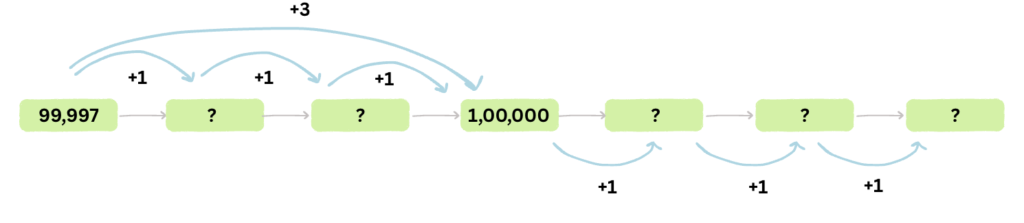
So, the first missing number is 99,997 + 1 = 99,998 and the second missing number is 99,998 + 1 = 99,999.
Continue this pattern of numbers increasing by 1 units to find the other missing numbers:
1,00,000 + 1 = 1,00,001 | 1,00,001 + 1 = 1,00,002 | 1,00,002 + 1 = 1,00,003
Q3. How large is 1,01,000 than one lakh? How small is 99,990 than one lakh?
Solution
One lakh = 1,00,000
1,01,000 One lakh = 1,01,000 1,00,000 = 1000
One lakh 99,990 = 1,00,000 99,990 = 10
So, 1,01,000 is larger than one lakh by 1000 and 99,990 is smaller than one lakh by 10.
Q4. The population of a town was 87,675 in the year 2025. By the following year, the population had increased by 38,000.
(a) Find the population of the town in 2026.
(b) If the population is projected to grow by the same number of people the next year, estimate the population for 2027.
Solution
(a) Population of the town in 2026 = Population of the town in 2025 + 38,000 = 87,675 + 38,000 = 1,25,675
(b) Estimated population of the town in 2027 = Population of the town in 2026 + 38,000 = 1,25,675 + 38,000 = 1,63,675
Q5. Write the following numbers in words:
(a) 52,47,899 (b) 99,99,999 (c) 1,23,456 (d) 12,34,567
Solution
(a) 52,47,899: Fifty two lakh forty seven thousand eight hundred ninety nine
(b) 99,99,999: Ninety nine lakh ninety nine thousand nine hundred ninety nine
(c) 1,23,456: One lakh twenty three thousand four hundred fifty six
(d) 12,34,567: Twelve lakh thirty four thousand five hundred sixty seven
Q6. Give the corresponding numbers in the Indian place value system for the following numbers:
(a) Eighty seven lakh fifty eight thousand two hundred thirty four (b) Eight lakh seventy five thousand eight hundred twenty three
(c) Twenty three lakh ninety nine thousand nine hundred eighty eight (d) Eighty eight lakh ninety nine thousand nine hundred thirty two
Solution
(a) Eighty seven lakh fifty eight thousand two hundred thirty four: 87,58,234
(b) Eight lakh seventy five thousand eight hundred twenty three: 8,75,823
(c) Twenty three lakh ninety nine thousand nine hundred eighty eight: 23,99,988
(d) Eighty eight lakh ninety nine thousand nine hundred thirty two: 88,99,932
Q7. What number is obtained if a +1000 button is pressed:
(a) 50 times (b) 7658 times (c) 999 times (d) 100 times
Solution
(a) Number obtained
(b) Number obtained
(c) Number obtained
(d) Number obtained
Q8. How many times should a +1000 button be pressed to show the following numbers:
(a) 7,65,000 (b) Twenty lakh (c) Fifty five lakh twenty three thousand (d) 34,000
Solution
(a) Number of presses
(b) Number of presses
(c) Number of presses
(d) Number of presses
Q9. How many thousands are required to make ten lakhs?
Solution
Number of thousands required to make ten lakhs
Q10. (i) How many times should a +100 button be pressed to show the following numbers:
(a) Ten lakh (b) Five lakh fifty five thousand five hundred (c) 23,45,700 (d) 9900
(ii) How many times should a +10 button be pressed to show the following numbers:
(a) 99,99,990 (b) Ten lakh (c) 11,11,110 (d) Five lakh fifty five thousand five hundred
Solution
(i) (a) Number of presses
(b) Number of presses
(c) Number of presses
(d) Number of presses
(ii) (a) Number of presses
(b) Number of presses
(c) Number of presses
(d) Number of presses
Q11. State whether the following statements are true or false:
(a) There are numbers which cannot be produced using +10 buttons and +1000 buttons but can be produced using +100 buttons.
(b) There are numbers which cannot be produced using +100 buttons but can be produced using +10 buttons.
Solution
(a) False: If a number can be produced using +100 buttons, then it can definitely be produced using +10 buttons as 100 is divisible by 10. Pressing a +100 button once is equivalent to pressing a +10 button ten times. (But note that there are numbers that can be produced using +100 button but not using +1000 buttons with 600 being an example which can be produced by pressing the +100 button 6 times, but cannot be produced using the +1000 button as it is less than 1000.)
(b) True: Numbers such as 20, 50, 90, etc. can be produced using +10 buttons but not using +100 buttons.
Q12. Build the following numbers in different ways using +1, +10, +100, +1000, +10,000, +1,00,000, and +10,00,000 buttons:
(a) 6,45,783 (b) 23,400 (c) One lakh (d) 999
Solution
(a) 6,45,783
So, 6,45,783 can be produced by pressing the +1,00,000 button six times, the +10,000 button four times, the +1000 button five times, the +100 button seven times, the +10 button eight times and the +1 button thrice.
6,45,783
So, 6,45,783 can also be produced by pressing the +10,000 button sixty four times, the +100 button fifty seven times, the +10 button seven times, and the +1 button thirteen times. (Note that there are several other ways the same number can be produced.)
(b) 23,400
So, 23,400 can be produced either by pressing the +100 button two hundred thirty four times or by pressing the +10 button two thousand three hundred forty times. (Note that there are several other ways the same number can be produced.)
(c) One lakh = 1,00,000
So, one lakh can be produced either by pressing the +1,00,000 button once or by pressing the +10,000 button ten times or the +1000 button one hundred times or the +100 button one thousand times or the +10 button ten thousand times or the +1 button one lakh times. (Note that there are several other ways the same number can be produced including combinations of different buttons.)
(d) 999
So, 999 can be produced by pressing the +100, +10, and +1 buttons nine times each.
999
So, 999 can also be produced by pressing the +100 button eight times, the +10 button nineteen times, and the +1 button nine times. (Note that there are several other ways the same number can be produced.)
Q13. What is the largest 3-digit number that can be made using exactly 30 presses?
Solution
Since the required number has 3 digits, it must lie between 100 and 999, and hence the buttons that can be used to produce the number are +1, +10, and +100.
To make the number as large as possible, we must press the +100 button as many times as possible (under the given condition). So, press it nine times giving the value (Note that pressing the +100 button ten times gives which is a 4-digit number.)
This leaves us with presses.
To make the number as large as possible, we must press the +10 button as many times as possible (within the given conditions).
- Pressing it ten times gives which gives the current value as which is a 4-digit number.
- Pressing it nine times gives which gives the current value as and the remaining number of presses as
- Next, press the +1 button as many times as the remaining number of presses. But pressing the +1 button twelve times gives 12 which gives the current value as which is a 4-digit number. So, we step back and reduce the number of presses of the +10 button to eight giving producing a current value of leaving behind presses. Next, press the +1 button thirteen times giving 13 which gives the final value as
Thus, the required number is 993.
Q14. What is the smallest 3-digit number that can be made using exactly 30 presses?
Solution
Since the required number has 3 digits, it must lie between 100 and 999, and hence the buttons that can be used to produce the number are +1, +10, and +100.
To make the number as small as possible, we must press the +1 button as many times as possible (under the given condition). Pressing it 30 times gives 30 which is a 2-digit number.
So, step back and reduce the number of presses of the +1 button to twenty nine giving 29, then press the +10 button once giving 10 thereby giving the current value as which is still a 2-digit number.
This means that we must use the +100 button at least once to produce a 3-digit number.
So, press the +100 button once and the +1 button twenty nine times (giving a total of 30 presses) to give the final value as
So, the required number is 129.
Q15. Using the +1, +10, +100, +1000, and +10,000 buttons, produce the following numbers using as few button presses as possible and give the least number of presses:
(a) 6703 (b) 234 (c) 1234 (d) 9999
Do you notice any pattern in the least number of presses?
Solution
To produce numbers using the least number of presses, match the digits of the numbers with the number of presses based on the place value representation of numbers. For instance, to produce the number 90 using the least number of presses, press the +10 button nine times. While pressing the +1 button ninety times yields the same number, the number of presses is not minimum in this case. Note that the +100 button cannot be pressed as 90 is less than 100. Similarly, to produce the number 23 using the least number of presses, press the +10 button twice and the +1 button thrice in which case the total number of presses is 2 + 3 = 5 (instead of 23 if the +1 button is pressed twenty three times).
(a)
So, press the +1000 button six times, the +100 button seven times, and the +1 button thrice to produce 6703 using the least number of presses.
Least number of presses
(b)
So, press the +100 button twice, the +10 button thrice, and the +1 button four times to produce 234 using the least number of presses.
Least number of presses
(c)
So, press the +1000 button once, the +100 button twice, the +10 button thrice, and the +1 button four times to produce 1234 using the least number of presses.
Least number of presses
(d)
So, press the +1, +10, +100, and +1000 buttons nine times each to produce 9999 using the least number of presses.
Least number of presses
Pattern: The least number of clicks in each case equals the digit sum of the number (which is the sum of the digits of the number).
Q16. Fill in the blanks:
(a) One hundred thousand = ____ lakh (b) ____ lakh = 1 crore (c) 1 million = ____ lakh (d) One thousand million = ____ billion
(e) 1 arab = ____ crore
Solution
(a) One hundred thousand = 100,000 = 1,00,000 = 1 lakh
(b) 1 crore = 1,00,00,000 = 100 lakh (One lakh is 1 followed by 5 zeros. So, 100 lakh is 1 followed by zeros.)
(c) 1 million = 1,000,000 = 10,00,000 = 10 lakh (One lakh is 1 followed by 5 zeros. So, 10 lakh is 1 followed by zeros.)
(d) One thousand million = 1,000,000,000 = 1 billion (One million is 1 followed by 6 zeros. So, one thousand million is 1 followed by zeros.)
(e) 1 arab = 1,00,00,00,000 = One hundred crore (One crore is 1 followed by 7 zeros. So, one hundred crore is 1 followed by zeros.)
Q17. Insert commas and write the number names of the following numbers according to the Indian as well as the international systems of numeration:
(a) 1234567 (b) 12345678 (c) 123456789 (d) 1234567890
Solution
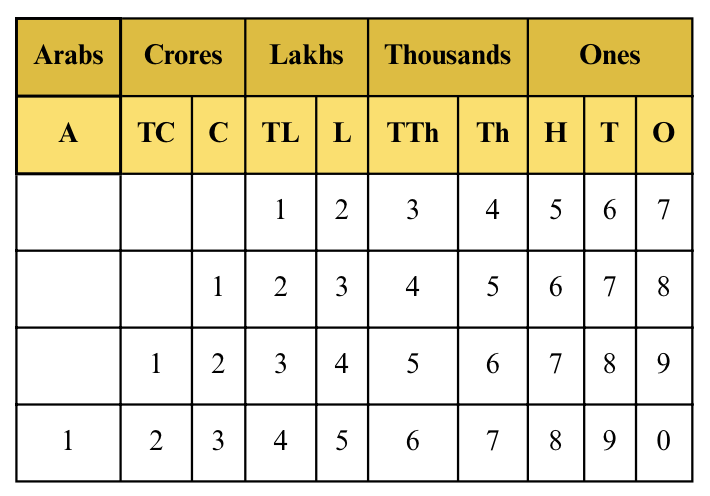
(a) On inserting commas as per the Indian system, we get 12,34,567 which reads as twelve lakh thirty four thousand five hundred sixty seven.
On inserting commas as per the international system, we get 1,234,567 which reads one million two hundred thirty four thousand five hundred sixty seven.
(b) On inserting commas as per the Indian system, we get 1,23,45,678 which reads as one crore twenty three lakh forty five thousand six hundred seventy eight.
On inserting commas as per the international system, we get 12,345,678 which reads twelve million three hundred forty five thousand six hundred seventy eight.
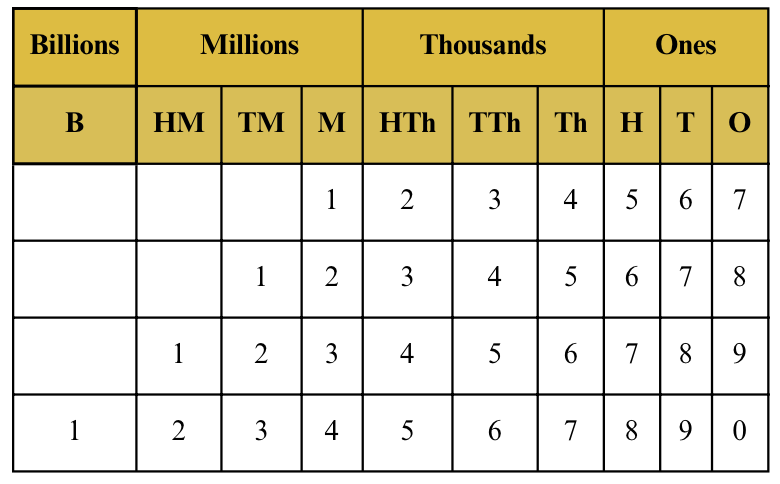
(c) On inserting commas as per the Indian system, we get 12,34,56,789 which reads as twelve crore thirty four lakh fifty six thousand seven hundred eighty nine.
On inserting commas as per the international system, we get 123,456,789 which reads one hundred twenty three million four hundred fifty six thousand seven hundred eighty nine.
(d) On inserting commas as per the Indian system, we get 1,23,45,67,890 which reads as one arab twenty three crore forty five lakh sixty seven thousand eight hundred ninety.
On inserting commas as per the international system, we get 1,234,567,890 which reads one billion two hundred thirty four million five hundred sixty seven thousand eight hundred ninety.
Q18. Give the following numbers in Indian place value notation:
(a) Thirty crore thirty lakh thirty thousand thirty (b) Two arab three crore four lakh six thousand nine
(c) Six hundred million sixty thousand fifty (d) Seven billion five million two thousand five
Solution
(a) Thirty crore thirty lakh thirty thousand thirty 30,30,30,030
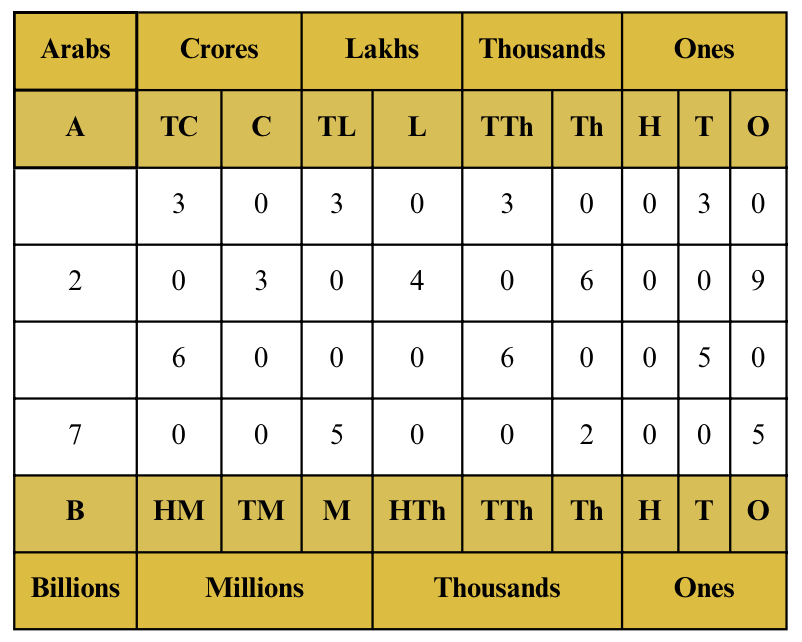
(b) Two arab three crore four lakh six thousand nine 2,03,04,06,009
(c) Six hundred million sixty thousand fifty 600,060,050 60,00,60,050
(d) Seven billion five million two thousand five 7,005,002,005 7,00,50,02,005
Q19. Fill in the blanks using <, >, or = signs:
(a) 5 million ____ 500 lakh (b) 7 crore ____ 70 million (c) 200 crore ____ 20 billion (d) 300 million ____ 3 arab
Solution
(a) 5 million = 5,000,000 = 50,00,000
1 lakh = 1,00,000 500 lakh = 5,00,00,000
50,00,000 has lesser number of digits than 5,00,00,000, and hence is smaller than 5,00,00,000.
Thus, 5 million < 500 lakh.
(b) 7 crore = 7,00,00,000
1 million = 1,000,000 70 million = 70,000,000 = 7,00,00,000
Thus, 7 crore = 70 million.
(c) 1 crore = 1,00,00,000 200 crore = 2,00,00,00,000
1 billion = 1,000,000,00020 billion = 20,00,00,00,000
2,00,00,00,000 has lesser number of digits than 20,00,00,00,000, and hence is smaller than 20,00,00,00,000.
Thus, 200 crore < 20 billion.
(d) 1 million = 1,000,000 300 million = 300,000,000 = 30,00,00,000
1 arab = 1,00,00,00,000 3 arab = 3,00,00,00,000
30,00,00,000 has lesser number of digits than 3,00,00,00,000, and hence is smaller than 3,00,00,00,000.
Thus, 300 million < 3 arab.
Q20. Give two situations when it is appropriate to:
(a) round up (b) round down (c) either round up or round down (d) give exact numbers
Solution
(a) 1. When buying supplies, we might need to round up the number of items to ensure that we do not run out.
2. When catering for a party, we might need to round up the quantity of food to ensure there is enough for everyone.
(b) 1. When shopping under a strict budget, we might need to round down costs to ensure that we stay within the fixed limit.
2. When determining the eligibility for using rides in a theme park, we might need to round down ages to ensure safety of the rider.
(c) 1. When casually reporting time to a friend, it is acceptable to either round up or round down.
2. When giving directions to a landmark, it is acceptable to either round up or round down distances.
(d) 1. When administering drugs to patients, it is important to use exact quantities.
2. When entering passwords for accounts, it is important to use exact numbers.
Q21. Round the following numbers to the nearest thousand, ten thousand, lakh, ten lakh, and crore:
(a) 1,23,45,678 (b) 12,34,56,789
Solution
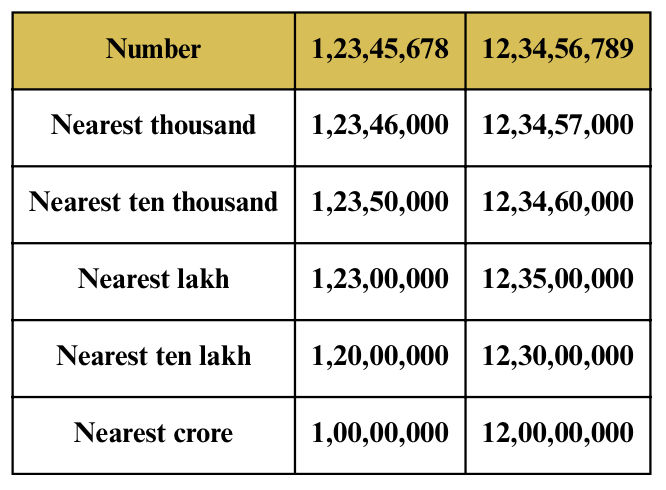
(a) Rounding off to the nearest thousand: Since the thousands digit is 5 and the digit 6 to its immediate right is greater than 5, this means 1,23,45,678 rounds up to 1,23,46,000.
Rounding off to the nearest ten thousand: Since the ten thousands digit is 4 and the digit to its immediate right is 5, this means 1,23,45,678 rounds up to 1,23,50,000.
Rounding off to the nearest lakh: Since the lakhs digit is 3 and the digit 4 to its immediate right is less than 5, this means 1,23,45,678 rounds down to 1,23,00,000.
Rounding off to the nearest ten lakh: Since the ten lakhs digit is 2 and the digit 3 to its immediate right is less than 5, this means 1,23,45,678 rounds down to 1,20,00,000.
Rounding off to the nearest crore: Since the crores digit is 1 and the digit 2 to its immediate right is less than 5, this means 1,23,45,678 rounds down to 1,00,00,000.
Note: 1,23,46,000, 1,23,50,000, 1,23,00,000, 1,20,00,000, and 1,00,00,000 are the nearest five neighbours of the given number.
(b) Rounding off to the nearest thousand: Since the thousands digit is 6 and the digit 7 to its immediate right is greater than 5, this means 12,34,56,789 rounds up to 12,34,57,000.
Rounding off to the nearest ten thousand: Since the ten thousands digit is 5 and the digit 6 to its immediate right is greater than 5, this means 12,34,56,789 rounds up to 12,34,60,000.
Rounding off to the nearest lakh: Since the lakhs digit is 4 and the digit to its immediate right is 5, this means 12,34,56,789 rounds up to 12,35,00,000.
Rounding off to the nearest ten lakh: Since the ten lakhs digit is 3 and the digit 4 to its immediate right is less than 5, this means 12,34,56,789 rounds down to 12,30,00,000.
Rounding off to the nearest crore: Since the crores digit is 2 and the digit 3 to its immediate right is less than 5, this means 12,34,56,789 rounds down to 12,00,00,000.
Q22.